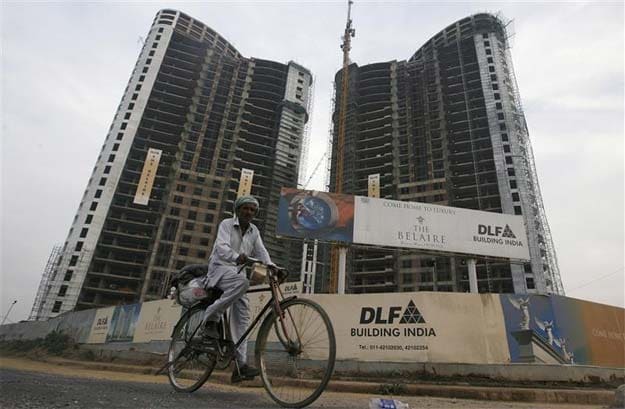
The Orbit Grand, a block-size complex designed to have at least 26 floors of elegant apartments, an extensive array of ground-floor stores and abundant parking for the chauffeured cars of residents and shoppers, was supposed to be a diadem of India’s real estate market.
Now it is turning into a symbol of the slumping fortunes of property developers and owners in a once-promising emerging economy. Construction of the Orbit Grand has almost completely stalled at the 10th floor, the tower crane at the site seldom moves and the builder has defaulted on its loan.
“There’s no real work going on right now. There’s just a minimum number of workers coming in to do small things,” said Alam Sheikh, an electrician who is one of just 14 builders left at the site.
The real estate market in cities across India is crumbling as the Indian economy slows. The rupee has dropped nearly 20 percent against the dollar since early May, scaring away foreign investors.
The Reserve Bank of India raised a key short-term interest rate for commercial banks’ borrowing by two full percentage points in mid-July, to 10.25 percent, mainly to prevent further declines in the rupee. To put a brake on the flow of money leaving the country, the central bank followed up last month with a regulation banning Indians from transferring money overseas for real estate purchases.
Rising financing costs are all the more painful because India’s real estate developments take a long time to build because of a vast and often corrupt regulatory apparatus. Publicly traded real estate investment groups in India are heavily in debt, so they struggle to make interest payments and are not in a position to bankroll further projects.

That combination has produced almost unanimous bearishness about the short-term prospects for residential, commercial and industrial real estate prices in India. Sanjay Dutt, the executive managing director for South Asia at Cushman & Wakefield, the world’s largest privately held commercial real estate company, predicted that prices would fall 10 percent in big Indian cities and 15 percent on the outskirts of large cities, where many speculative projects have been built. He said, “Given the universal sentiment of the market, there could be a sharp correction between now and Gudi Padwa,” an annual festival next March that has long been considered in India an auspicious time to buy real estate.
What has sustained prices so far, and what might prevent more serious losses than those predicted by Dutt, has been the willingness of developers to hold growing inventories of unsold apartments, shops and offices without offering price discounts. The volume of real estate transactions has slumped in India as developers have refused to offer discounts for fear of starting a market rout.
“If they drop prices, investors will panic and it will be a self-fulfilling prophecy,” causing further declines in prices, said Siddharth Yog, a co-founder and managing partner of the Xander Group, a large international real estate investment firm started in 2005. That was the year India began allowing foreign institutional investors into its real estate market.
But with sellers refusing to cut prices, many potential buyers are losing interest. Devkinandan Agarwal, a Mumbai broker with three-quarters of his business in residential real estate and the rest in commercial real estate, said that until the last few months, he had at least three or four separate meetings each day with genuine, interested buyers; now he has only one a day.
“There are now only actual users in the market, there is hardly anyone buying real estate as an investment,” he said.
One longstanding complaint about business practices in India is that the country’s banks lend heavily to a wealthy elite who often put very little of their own money into deals. These developers rely on minority investors and bank loans for most of the financing. India’s debt tribunals, for companies unable to repay what they have borrowed, have tended to move slowly. They are reluctant to force founders of companies to incur large losses even in corporate reorganizations in which creditors and minority investors lose heavily.
Raghuram Rajan, the new governor of the Reserve Bank of India, said at his inaugural news conference last Wednesday that he would try to change this. “Promoters do not have a divine right to stay in charge regardless of how badly they mismanage an enterprise, nor do they have the right to use the banking system to recapitalize their failed ventures,” he said.
Bimal Jalan, a former chief economic adviser to the Indian government who was also the governor of the central bank from 2000 to 2004, said in a telephone interview from New Delhi that the broader Indian economy could escape serious harm even if real estate prices did decline. India has low rates of homeownership, so families are less likely to be worried about falling home prices and cut household spending.
Housing finance has played a small role in the Indian banking system, so Indian banks are less vulnerable to real estate downturns than banks in the West, Jalan said. Regulatory obstacles have slowed the pace of construction and limited the number of buildings to finance.
The construction of the Orbit Grand here illustrates many of the issues in Indian real estate, including costly regulatory delays. The Orbit Corporation, a publicly traded Mumbai developer, began building the complex and several others in western India with a $62 million loan in 2008 from LIC Housing Finance Ltd., based in Mumbai. But a combination of litigation over whether Orbit had full title to the entire site, which Orbit did not win until last March, together with a new set of municipal real estate regulations introduced in late 2010, slowed the pace of construction and prevented Orbit from preselling apartments. The company actually had to erect two separate buildings, with plans to join them together later, because the litigation, a chronic problem in Indian real estate, delayed construction on the 30 percent of the site’s acreage that was in question.
“This led to a severe cash crunch at the company and resulted in the stalling construction of the project,” said Ramashrya Yadav, the chief financial officer at Orbit.
Orbit defaulted on the LIC loan at the end of last year with a little more than a third of the original balance not yet repaid. LIC put the Orbit Grand into receivership in early August. But as often happens in India, Orbit has kept control of the sites.
Yadav said that Orbit had now raised the money to finish the projects, and it received the needed environmental clearances four weeks ago. The Orbit Grand stalled with 10 stories completed out of 26, although the firm is seeking regulatory approval to extend the building up to 36 stories. Another project, less than a mile away, Orbit Terraces, stalled with 40 of 60 floors built.
Orbit requires the permission of LIC to sell units, and any sales must go toward the defaulted loan. Mr. Yadav predicted that Orbit would be able to repay the defaulted loan within seven months, while acknowledging that the company faced a tough market for selling apartments. “As liquidity dries up, a price fall is also imminent,” he said. LIC declined to comment.
While foreign investors in Indian real estate are licking their wounds after the 17.5 percent fall in the rupee against the dollar since the start of May, they do have one consolation. The longstanding shortage of space in many Indian cities because of regulatory barriers to new construction translates into high occupancy rates and steady rental incomes for commercial and residential real estate, at least in rupee terms.
“In terms of the underlying portfolio, tenant demand has been very good — there has been limited construction in the last few years because of tight credit, and that has slowed the supply of new offices,” said Christopher Heady, the Blackstone partner overseeing Asian real estate investments. The asset management firm Blackstone has invested $600 million in Indian real estate, mainly office complexes in Bangalore, a center of the information technology and outsourcing industries in southern India.
These sectors have a lot of multinationals and big Indian companies that are reliable renters, Mr. Heady said, adding that these clients are “continuing to grow pretty rapidly.”
But leaving aside a few exporters of services like computer software, most of the economy is struggling. Manish Jain moved his jewelry store last January into retail space at the base of the unfinished Orbit Grand, but has found that customers are more interested in pawning jewelry they already have — and the people doing the pawning are increasingly those wearing suits, not just shirts or saris. “They are going through a tough financial crisis,” he said. “At first, we only saw people from the service class, lower-income people, but now we are seeing business people, too.”
Source : http://timesofindia.indiatimes.com/business/india-business/Housing-slump-Real-estate-market-crumbles-as-economy-slows/articleshow/22479932.cms
Now it is turning into a symbol of the slumping fortunes of property developers and owners in a once-promising emerging economy. Construction of the Orbit Grand has almost completely stalled at the 10th floor, the tower crane at the site seldom moves and the builder has defaulted on its loan.
“There’s no real work going on right now. There’s just a minimum number of workers coming in to do small things,” said Alam Sheikh, an electrician who is one of just 14 builders left at the site.
The real estate market in cities across India is crumbling as the Indian economy slows. The rupee has dropped nearly 20 percent against the dollar since early May, scaring away foreign investors.
The Reserve Bank of India raised a key short-term interest rate for commercial banks’ borrowing by two full percentage points in mid-July, to 10.25 percent, mainly to prevent further declines in the rupee. To put a brake on the flow of money leaving the country, the central bank followed up last month with a regulation banning Indians from transferring money overseas for real estate purchases.
Rising financing costs are all the more painful because India’s real estate developments take a long time to build because of a vast and often corrupt regulatory apparatus. Publicly traded real estate investment groups in India are heavily in debt, so they struggle to make interest payments and are not in a position to bankroll further projects.
That combination has produced almost unanimous bearishness about the short-term prospects for residential, commercial and industrial real estate prices in India. Sanjay Dutt, the executive managing director for South Asia at Cushman & Wakefield, the world’s largest privately held commercial real estate company, predicted that prices would fall 10 percent in big Indian cities and 15 percent on the outskirts of large cities, where many speculative projects have been built. He said, “Given the universal sentiment of the market, there could be a sharp correction between now and Gudi Padwa,” an annual festival next March that has long been considered in India an auspicious time to buy real estate.
What has sustained prices so far, and what might prevent more serious losses than those predicted by Dutt, has been the willingness of developers to hold growing inventories of unsold apartments, shops and offices without offering price discounts. The volume of real estate transactions has slumped in India as developers have refused to offer discounts for fear of starting a market rout.
“If they drop prices, investors will panic and it will be a self-fulfilling prophecy,” causing further declines in prices, said Siddharth Yog, a co-founder and managing partner of the Xander Group, a large international real estate investment firm started in 2005. That was the year India began allowing foreign institutional investors into its real estate market.
But with sellers refusing to cut prices, many potential buyers are losing interest. Devkinandan Agarwal, a Mumbai broker with three-quarters of his business in residential real estate and the rest in commercial real estate, said that until the last few months, he had at least three or four separate meetings each day with genuine, interested buyers; now he has only one a day.
“There are now only actual users in the market, there is hardly anyone buying real estate as an investment,” he said.
One longstanding complaint about business practices in India is that the country’s banks lend heavily to a wealthy elite who often put very little of their own money into deals. These developers rely on minority investors and bank loans for most of the financing. India’s debt tribunals, for companies unable to repay what they have borrowed, have tended to move slowly. They are reluctant to force founders of companies to incur large losses even in corporate reorganizations in which creditors and minority investors lose heavily.
Raghuram Rajan, the new governor of the Reserve Bank of India, said at his inaugural news conference last Wednesday that he would try to change this. “Promoters do not have a divine right to stay in charge regardless of how badly they mismanage an enterprise, nor do they have the right to use the banking system to recapitalize their failed ventures,” he said.
Bimal Jalan, a former chief economic adviser to the Indian government who was also the governor of the central bank from 2000 to 2004, said in a telephone interview from New Delhi that the broader Indian economy could escape serious harm even if real estate prices did decline. India has low rates of homeownership, so families are less likely to be worried about falling home prices and cut household spending.
Housing finance has played a small role in the Indian banking system, so Indian banks are less vulnerable to real estate downturns than banks in the West, Jalan said. Regulatory obstacles have slowed the pace of construction and limited the number of buildings to finance.
The construction of the Orbit Grand here illustrates many of the issues in Indian real estate, including costly regulatory delays. The Orbit Corporation, a publicly traded Mumbai developer, began building the complex and several others in western India with a $62 million loan in 2008 from LIC Housing Finance Ltd., based in Mumbai. But a combination of litigation over whether Orbit had full title to the entire site, which Orbit did not win until last March, together with a new set of municipal real estate regulations introduced in late 2010, slowed the pace of construction and prevented Orbit from preselling apartments. The company actually had to erect two separate buildings, with plans to join them together later, because the litigation, a chronic problem in Indian real estate, delayed construction on the 30 percent of the site’s acreage that was in question.
“This led to a severe cash crunch at the company and resulted in the stalling construction of the project,” said Ramashrya Yadav, the chief financial officer at Orbit.
Orbit defaulted on the LIC loan at the end of last year with a little more than a third of the original balance not yet repaid. LIC put the Orbit Grand into receivership in early August. But as often happens in India, Orbit has kept control of the sites.
Yadav said that Orbit had now raised the money to finish the projects, and it received the needed environmental clearances four weeks ago. The Orbit Grand stalled with 10 stories completed out of 26, although the firm is seeking regulatory approval to extend the building up to 36 stories. Another project, less than a mile away, Orbit Terraces, stalled with 40 of 60 floors built.
Orbit requires the permission of LIC to sell units, and any sales must go toward the defaulted loan. Mr. Yadav predicted that Orbit would be able to repay the defaulted loan within seven months, while acknowledging that the company faced a tough market for selling apartments. “As liquidity dries up, a price fall is also imminent,” he said. LIC declined to comment.
While foreign investors in Indian real estate are licking their wounds after the 17.5 percent fall in the rupee against the dollar since the start of May, they do have one consolation. The longstanding shortage of space in many Indian cities because of regulatory barriers to new construction translates into high occupancy rates and steady rental incomes for commercial and residential real estate, at least in rupee terms.
“In terms of the underlying portfolio, tenant demand has been very good — there has been limited construction in the last few years because of tight credit, and that has slowed the supply of new offices,” said Christopher Heady, the Blackstone partner overseeing Asian real estate investments. The asset management firm Blackstone has invested $600 million in Indian real estate, mainly office complexes in Bangalore, a center of the information technology and outsourcing industries in southern India.
These sectors have a lot of multinationals and big Indian companies that are reliable renters, Mr. Heady said, adding that these clients are “continuing to grow pretty rapidly.”
But leaving aside a few exporters of services like computer software, most of the economy is struggling. Manish Jain moved his jewelry store last January into retail space at the base of the unfinished Orbit Grand, but has found that customers are more interested in pawning jewelry they already have — and the people doing the pawning are increasingly those wearing suits, not just shirts or saris. “They are going through a tough financial crisis,” he said. “At first, we only saw people from the service class, lower-income people, but now we are seeing business people, too.”
Source : http://timesofindia.indiatimes.com/business/india-business/Housing-slump-Real-estate-market-crumbles-as-economy-slows/articleshow/22479932.cms